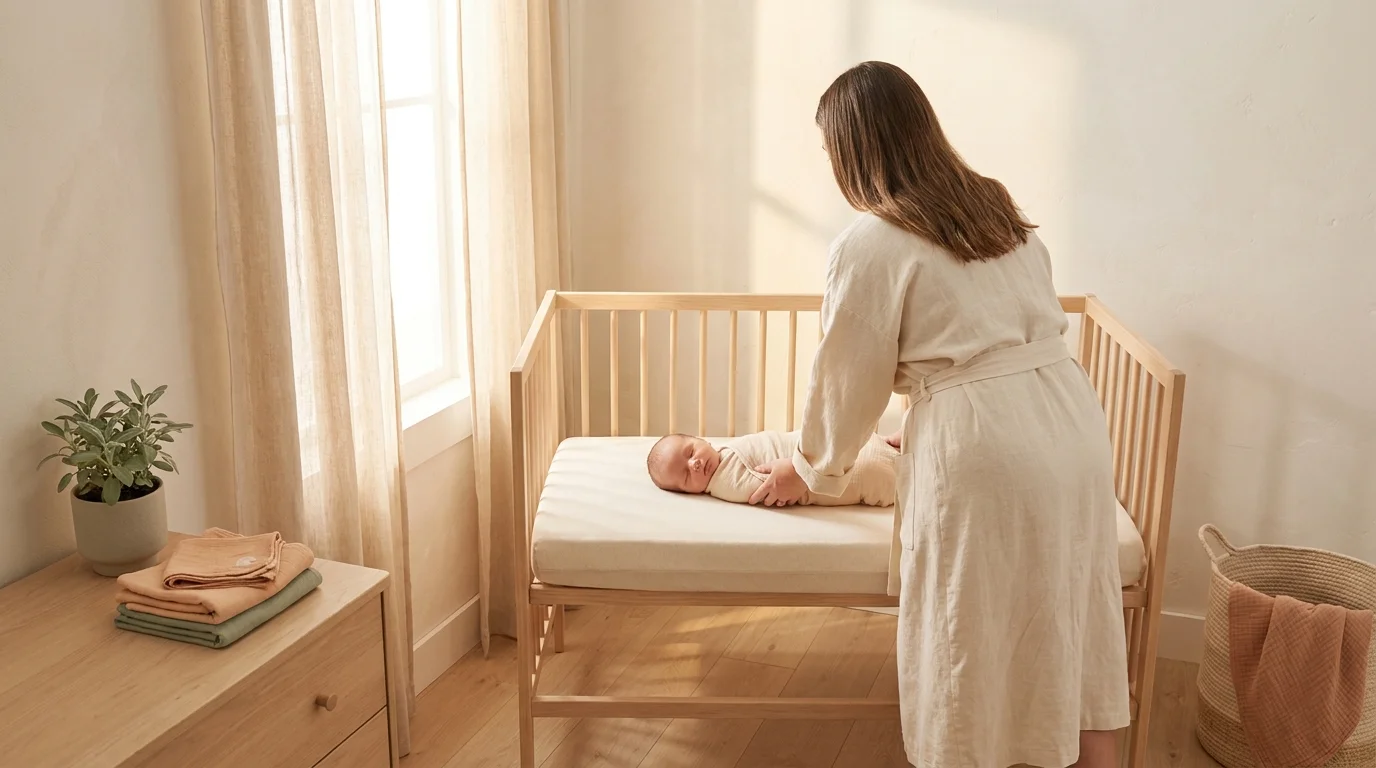
Why Your Newborn Wakes Up So Often at Night
Nothing quite prepares you for the reality of newborn nights. You may have read the books, attended the classes, and still found yourself standing in the dark at 3 a.m. wondering how something so small can need so much, so often. You are not alone, and you are not doing anything wrong. Newborn night wakings are not a problem to be solved. They are a biological reality, and understanding why they happen can make them feel a lot less overwhelming.
Newborns have stomachs roughly the size of a walnut in the first few days of life, growing to about the size of an apricot by the end of the first week. Because breast milk and formula digest relatively quickly, your baby genuinely needs to feed frequently, including overnight. This is not a habit, and it is not something you created. It is simply how newborn physiology works.
Beyond hunger, newborns also have immature circadian rhythms. The internal clock that tells adults to feel sleepy at night and alert during the day takes several months to develop in babies. Research from the National Institute of Child Health and Human Development confirms that newborns spend a large proportion of their sleep in active (REM) sleep, which is lighter and more easily disrupted than the deep sleep adults experience. This is actually protective: lighter sleep is thought to reduce the risk of sudden infant death syndrome (SIDS) by making it easier for babies to rouse themselves if breathing is compromised.
"Frequent night waking in the first months of life is not only normal but developmentally appropriate. Parents who understand this tend to experience less anxiety and respond to their babies with greater sensitivity."
- Dr. Megan Tompkins, PhD, CBSM, Pediatric Sleep Specialist, University of Michigan Sleep Disorders Center
What Is Actually Normal? (The Real Numbers)
One of the most exhausting parts of early parenthood is not knowing whether what you are experiencing is typical. When every parenting forum seems to feature a baby who sleeps through the night at six weeks, it is easy to feel like something is wrong. The truth is far less tidy, and far more reassuring.
In the first month, most newborns wake every one to three hours around the clock. By two to three months, many babies have one slightly longer stretch of three to five hours, usually in the first part of the night. Sleeping through the night, which pediatricians define as a five to six hour stretch, is not expected until closer to four to six months, and many healthy babies do not consistently achieve this until much later.
A landmark study published in the journal Pediatrics found that at six months of age, only 43 percent of infants slept through the night consistently, and a significant percentage continued waking regularly well into the second year of life. The American Academy of Pediatrics acknowledges this wide variation and encourages parents to focus on responding to their baby's cues rather than chasing a specific sleep milestone.
What influences how often your baby wakes? Several factors come into play:
- Feeding method: Breastfed babies often wake more frequently because breast milk digests faster than formula.
- Growth spurts: Babies going through rapid development phases, typically around two, three, and six weeks, tend to feed and wake more often.
- Developmental leaps: Cognitive and motor development can temporarily disrupt sleep patterns.
- Individual temperament: Some babies are simply lighter sleepers than others, and this is not something you caused.
The Real Impact of Sleep Deprivation on New Parents
It would be dismissive to talk about night wakings without honestly addressing what they do to you. Sleep deprivation is not just tiredness. It is a physiological stressor that affects mood, cognition, immune function, and emotional regulation. New parents, and especially new mothers who are also recovering physically from birth and potentially breastfeeding, carry a disproportionate burden of nighttime caregiving.
"Sleep deprivation in postpartum women is a significant contributor to mood disorders including postpartum depression. Prioritising even small pockets of consolidated sleep is not a luxury; it is a clinical recommendation."
- Dr. Wendy Davis, PsyD, Executive Director, Postpartum Support International
The National Institute of Mental Health identifies sleep disruption as one of the key risk factors for postpartum mood disorders. This is not meant to alarm you, but to validate that what you are experiencing has real neurological weight. It is not weakness to find this hard. It is biology.
Some honest truths about sleep deprivation in the newborn period:
- Broken sleep is significantly less restorative than consolidated sleep, even when the total hours are similar.
- The mental load of anticipating a wake-up can prevent deep sleep even during rest periods.
- Partners and co-parents are often also significantly sleep deprived, which can increase relationship tension during an already demanding period.
Key Takeaway
Feeling utterly exhausted does not mean you are coping poorly. It means you are human, doing one of the most demanding physical and emotional jobs that exists. Seeking support and protecting your sleep where possible is not selfish; it is essential for both you and your baby.
Practical Strategies That Actually Help
While you cannot rush your baby's developmental readiness for longer sleep stretches, there are evidence-informed strategies that can make the night waking period more manageable and help you gather slightly more rest.
Prioritise Your Own Sleep During the Day
The advice to "sleep when the baby sleeps" is often met with eye rolls, particularly when there are older children, household responsibilities, or simply the mental unwinding time that is needed during naps. But even ten to twenty minutes of lying down with eyes closed can provide measurable restoration. If full sleep is not possible, rest without screens still reduces cortisol and supports recovery.
Share the Night Load Where Possible
If you have a partner, consider deliberate shift arrangements. One approach is to split the night: one person takes all wakings until a set time (say, 1 a.m. or 2 a.m.) and then the other takes over for the rest of the night. This allows each person at least one longer unbroken stretch. If you are breastfeeding, a partner can handle settling and nappy changes while you feed, then return the baby to sleep so you can rest more quickly.
Create a Calming Night Environment
Keeping night feeds and changes as calm and low-stimulation as possible helps signal to your baby that night is for sleeping, not socialising. Use dim lighting (red or amber tones are least disruptive to melatonin), keep voices quiet and interactions minimal, and avoid changing nappies unless necessary (i.e. for soiling, not just wetness, if your nappy brand can hold it safely overnight).
Learn to Read Your Baby's Sleep Cues
Catching your baby at the first signs of tiredness, rather than waiting until they are overtired and harder to settle, can reduce the time it takes to get them back to sleep. Early cues include: losing interest in activity, slight eye rubbing, a brief glazed look, or turning away from stimulation. Overtired cues, which signal you have missed the window, include arching the back, inconsolable fussing, and difficulty latching.
Consider a Safe Co-Sleeping Setup
Bedsharing remains controversial, but side-car bassinet arrangements, where a bedside sleeper attaches directly to the adult mattress, allow for easier night feeds without full bedsharing and are widely considered safe when used correctly. The American Academy of Pediatrics Safe Sleep Guidelines recommend room-sharing (but not bed-sharing) for at least the first six months, as this is associated with a reduced risk of SIDS while also making responsive feeding easier overnight.
Track Patterns to Find Predictability
When every night feels chaotic, it can help to track wake times, feed durations, and settling times over a few days. Often, patterns emerge that are not obvious in the fog of exhaustion. Knowing that your baby tends to have a longer first stretch followed by two-hourly wakings from 2 a.m. gives you a framework to work within and prepare for, rather than being blindsided each night.
When Night Wakings Signal Something More
Frequent night waking is normal, but there are some scenarios worth discussing with your pediatrician or health visitor. These include:
- Waking accompanied by significant distress that is very difficult to settle, which may indicate reflux, colic, or another discomfort
- A sudden increase in waking frequency in a previously more settled baby, particularly if accompanied by feeding difficulties or poor weight gain
- A baby who seems difficult to rouse after sleep, or who appears unusually pale, limp, or difficult to wake
- A parent whose mood or mental health is significantly impacted by sleep deprivation, to the point of feeling unsafe or unable to care for the baby
None of these are causes for immediate alarm, but they are all worth a conversation with a professional who knows your baby's full picture.
Looking Ahead: When Does It Get Better?
It does get better, though the timeline varies enormously between babies and families. Most parents notice a meaningful shift in night sleep somewhere between three and six months, when circadian rhythms begin to mature and babies gain capacity for slightly longer sleep cycles. Some families continue navigating night wakings well into the toddler years, and this too is within the range of normal human infant development.
What changes faster than the sleep itself is usually your own capacity to function within it. The body does adapt to a degree, and most parents find that by six to eight weeks, the acute shock of newborn nights has softened into something more manageable, even if the frequency of wakings has not dramatically changed.
The most important thing to hold onto: this phase is finite. It does not feel that way at 4 a.m. But every night you get through is one night closer to longer stretches, and the version of you who looks back on this period will feel proud of how you showed up, even when you were running on almost nothing.
Key Statistics and Sources
- Only 43% of six-month-old infants sleep through the night consistently. AAP Pediatrics, 2018
- Newborns spend up to 50% of their sleep time in active (REM) sleep, compared to about 20% in adults. NICHD
- Room-sharing (without bed-sharing) is associated with a 50% reduction in SIDS risk. AAP Safe Sleep Guidelines
- Sleep disruption is one of the leading modifiable risk factors for postpartum depression. NIMH
- Newborn stomach capacity grows from approximately 5-7ml on day one to 45-60ml by day ten. NICHD Breastfeeding
- Broken or fragmented sleep produces significantly greater cognitive impairment than equivalent-duration consolidated sleep loss. NIH/NCBI Sleep Research