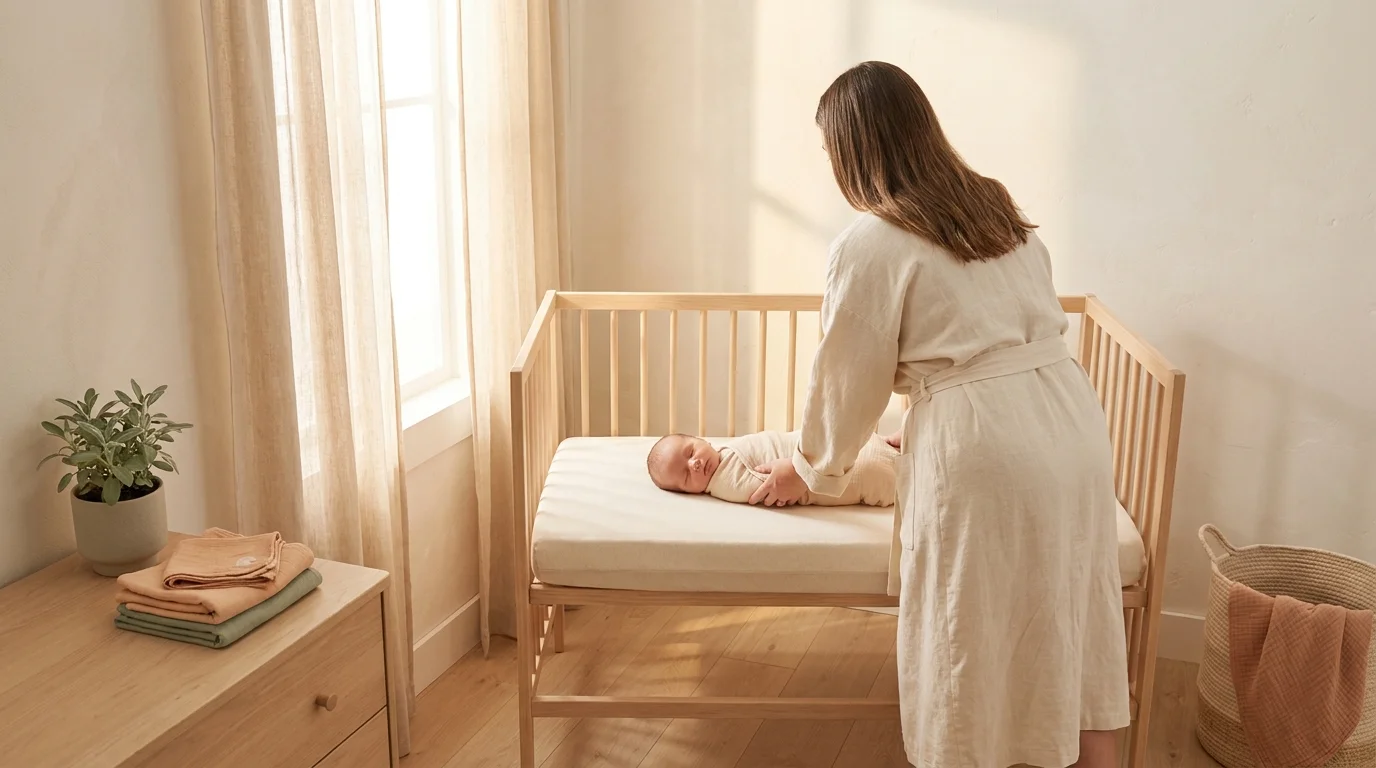
Why Newborn Sleep Feels So Chaotic (And Why That's Normal)
Nothing quite prepares you for the reality of newborn sleep. You imagined a drowsy baby who drifts off peacefully after feeds, but instead you're standing in the dark at 3 a.m., swaying a wide-awake infant and wondering what went wrong. The honest answer: nothing went wrong. Newborn sleep is genuinely different from adult sleep in almost every measurable way, and understanding that difference is the first step toward surviving, and even shaping, those early weeks with more confidence.
In the first weeks of life, a newborn typically sleeps between 14 and 17 hours per day, spread across short stretches of two to four hours at a time. According to the National Institute of Child Health and Human Development (NICHD), newborns do not yet have a developed circadian rhythm, the internal clock that tells the rest of us when it's day and when it's night. That clock takes several weeks to months to establish, which is why your newborn treats 2 a.m. as perfectly reasonable time for a social interaction.
This article isn't about sleep training (that's a conversation for later months). It's about the gentle, evidence-informed routines you can begin building from the very earliest weeks to support your baby's developing sleep biology and protect your own wellbeing in the process.
How Newborn Sleep Actually Works
Adult sleep cycles last roughly 90 minutes, alternating between light and deep phases. Newborn sleep cycles are much shorter, around 45 to 50 minutes, and they spend a significantly higher proportion of their sleep in active (REM) sleep compared to adults. Research published in the National Library of Medicine confirms that this abundance of REM sleep is not accidental: it plays a critical role in rapid brain development, synaptic pruning, and memory consolidation during a period of extraordinary neural growth.
This means your newborn will often stir, flutter their eyelids, make small sounds, and even twitch during sleep. These are not signs they are waking up or that something is wrong. They are signs of a brain working overtime to build itself.
"Parents are often alarmed by how active their newborn looks during sleep, but that active sleep state is doing important developmental work. The worst thing we can do is rush in and fully rouse a baby who is simply cycling through a normal sleep phase."
Dr. Judith Owens, MD, MPH, Director of Sleep Medicine, Boston Children's Hospital
The Difference Between a Schedule and a Routine
In the newborn stage, chasing a fixed clock-based schedule often leads to frustration because your baby's hunger and sleep cues don't follow a neat timetable yet. What works far better in the early weeks is building a routine: a predictable sequence of events that signals to your baby's developing nervous system what comes next.
Think of it as teaching your newborn a language before they can speak. When the same gentle sequence happens before every sleep, bath, dim lights, a short feed, a soft song, a swaddle, that repetition becomes a sensory cue that rest is coming. Over days and weeks, the brain begins to associate those cues with the act of settling.
Key Takeaway: Routine vs. Schedule
- A schedule is clock-based (e.g., nap at 10 a.m. every day). This is hard to achieve before 3 to 4 months.
- A routine is sequence-based (e.g., always: dim lights, feed, swaddle, settle). This can start in week one.
- Routines build predictability without the rigidity that makes newborn care even harder.
Building a Gentle Sleep Routine: Week by Week
Weeks 1 to 2: Focus on Recovery, Not Routine
In the first two weeks, your job is not to build habits. It's to recover, establish feeding, and respond to your baby's cues without expectation. Feed on demand, sleep when you can, and let this period be what it is: an intensive, beautiful, exhausting adjustment. The single most important thing you can do in these early days is to practice safe sleep every time your baby sleeps, regardless of what time it is or how they got there.
The American Academy of Pediatrics (AAP) recommends placing babies on their back, on a firm flat surface, in their own sleep space, free of loose bedding, bumpers, or soft objects, for every sleep. Room-sharing without bed-sharing is recommended for at least the first six months as it has been shown to reduce the risk of Sudden Infant Death Syndrome (SIDS).
Weeks 3 to 6: Begin Layering Cues
Around week three, you can start introducing gentle environmental cues that distinguish day from night. During daytime naps, let some natural light filter in and don't silence normal household sounds. At night, keep things dark, quiet, and low-stimulation. When you tend to your baby at night, use a dim red-spectrum light (which is less disruptive to melatonin production than white or blue light) and keep interactions calm and brief.
At this stage you can also begin a simple pre-sleep sequence for the night stretch. It doesn't need to be elaborate. A short warm bath two or three times a week, a gentle feed in dimmed light, a swaddle, and soft white noise is plenty. The key is consistency: do the same things in the same order each evening.
Weeks 6 to 8: Watch for Drowsy-But-Awake Opportunities
One of the most repeated pieces of advice in infant sleep guidance is to put your baby down "drowsy but awake." This is worth understanding properly. When a baby falls completely asleep in your arms and is then placed in their cot, they often rouse during a lighter sleep phase and find themselves in a completely different environment from where they fell asleep. This mismatch triggers waking and crying.
Drowsy but awake means placing your baby in their sleep space when they are visibly sleepy but still have enough awareness to register where they are. They may fuss briefly, but they are learning, very gradually, that their sleep space is a safe and familiar place to rest. Don't expect this to work perfectly at first. Even small moments of success are meaningful progress.
"The drowsy-but-awake window is genuinely brief and easy to miss. Parents who learn to read their baby's earliest sleep cues, that first yawn, the glassy look in the eyes, the slight slowing of movement, are far more successful at gentle settling than those waiting for overtired cues like crying and arching."
Dr. Harvey Karp, MD, FAAP, Pediatrician and Author, Founder of Happiest Baby
Reading Your Baby's Sleep Cues
Overtiredness is one of the biggest obstacles to newborn sleep. When babies pass their sleep window, cortisol floods their system to keep them alert, and settling them then becomes significantly harder. Learning to spot early sleep cues is one of the most practical skills you can develop in the first weeks.
- Early cues: Yawning, eyes going slightly glassy or unfocused, slowing movements, quieting down, rubbing eyes or ears
- Mid cues: Fussiness, pulling at clothing, losing interest in play or stimulation
- Late cues: Crying, arching the back, inconsolable fussing
Aim to begin your settling routine at the first or second stage, before crying begins. Newborns can typically only handle 45 to 90 minutes of awake time before their bodies need to sleep again, and this window is even shorter in the first few weeks.
The Role of Light, Sound, and Environment
Your newborn spent nine months in an environment that was warm, dark, continuously moving, and filled with the rhythmic thud of your heartbeat and the muffled sound of your voice. The outside world, with its silence, stillness, and light, is genuinely startling to a newly born nervous system.
This is why many babies sleep better with white noise (which mimics the whooshing sounds of the womb), swaddling (which replicates the feeling of gentle containment), and being held or gently rocked (which echoes the movement they felt constantly in utero). These are not crutches. In the early weeks they are developmentally appropriate tools that support a nervous system that is still learning to self-regulate.
If you choose to use white noise, keep it at a safe volume: no louder than 50 decibels and placed at least one metre from your baby's head. This approximates the sound level inside the womb without risking hearing damage.
Managing Your Own Sleep in the Newborn Stage
You cannot function on four-hour total sleep indefinitely, and your wellbeing matters as much as your baby's. A few practical strategies that genuinely help:
- Sleep in shifts with a partner: One person takes the first half of the night, the other takes the second. Each person gets one longer stretch of sleep.
- Nap without guilt: The phrase "sleep when the baby sleeps" is imperfect, but a 20-minute nap during a daytime sleep can meaningfully reduce cumulative sleep debt.
- Limit night feeds to the essentials: Keep night interactions as brief and low-stimulus as possible so you can return to sleep more quickly.
- Ask for specific help: Instead of a general "let me know if you need anything," ask a family member or friend to take the baby for two hours on a specific morning so you can sleep.
Key Takeaway: What to Expect, Week by Week
- Weeks 1 to 2: 2 to 4 hour stretches, 14 to 17 hours total daily sleep, no pattern
- Weeks 3 to 6: Slight lengthening of night stretches for some babies; start layering environmental cues
- Weeks 6 to 8: More predictable wake windows emerging; drowsy-but-awake practice begins
- Month 3 to 4: Circadian rhythm begins to consolidate; longer night stretches become more common
When to Talk to Your Pediatrician
Most newborn sleep challenges are entirely developmental and resolve with time and gentle consistency. However, it's worth speaking with your pediatrician if your baby consistently struggles to settle despite all soothing measures, seems in pain or distress during or after feeds, snores or appears to stop breathing during sleep, or is sleeping significantly more or less than the expected range for their age.
These could point to underlying issues such as reflux, tongue tie, or (rarely) a sleep-related breathing disorder, all of which are treatable when identified early.
A Final Word: This Stage Does End
When you are in the thick of the newborn sleep fog, it can feel permanent. It isn't. Sleep patterns consolidate with remarkable speed as your baby's nervous system matures. The gentle routines you build now, even imperfect ones, are laying a foundation that will make later sleep development smoother. Trust the process, lean on your support, and be genuinely kind to yourself during one of the most demanding stages of new parenthood.
Key Statistics and Sources
- Newborns need 14 to 17 hours of sleep per day, according to the NICHD.
- Newborns spend approximately 50% of their sleep time in active (REM) sleep, compared to around 20% in adults. Source: National Library of Medicine.
- Room-sharing (without bed-sharing) can reduce the risk of SIDS by up to 50%, per the American Academy of Pediatrics.
- White noise above 85 decibels can damage infant hearing; safe levels are under 50 decibels at the baby's position. Source: National Library of Medicine, 2015.
- Circadian rhythm development typically begins around 6 to 8 weeks and becomes more established by 3 to 4 months. Source: NICHD.
- Consistent bedtime routines have been shown to improve sleep outcomes for infants and reduce maternal mood disturbances. Source: Mindell et al., 2009, PubMed.