Bringing a newborn home comes with a steep learning curve, and for families who have chosen circumcision for their baby boy, that curve includes understanding how to care for the healing site in the days and weeks that follow. It is completely normal to feel uncertain, even a little anxious, about what you are seeing and whether everything is progressing as it should.
This guide walks you through what to expect during recovery, how to keep the area clean and comfortable, which signs point to healthy healing, and which symptoms mean it is time to call your baby's pediatrician. Knowledge is the best tool you have right now, and you are already in the right place to get it.
What Happens During a Newborn Circumcision?
Circumcision is the surgical removal of the foreskin, the fold of skin that covers the tip of the penis. In the United States, it is one of the most commonly performed newborn procedures. According to the Centers for Disease Control and Prevention (CDC), rates of newborn male circumcision in U.S. hospitals have ranged from roughly 55 to 80 percent depending on region, though the national rate has shifted over recent decades.
The procedure is typically performed in the hospital within the first day or two of life, using one of several methods: the Gomco clamp, the Plastibell device, or the Mogen clamp. Each approach accomplishes the same goal but leaves the healing site looking slightly different. Your care team will explain which method was used and provide specific aftercare instructions before you leave the hospital. Always follow those instructions first, and use this article as a supportive companion resource alongside them.
The First 24 Hours: What to Expect
Right after the procedure, the tip of the penis will look red and may be slightly swollen. A small amount of bleeding, no more than a quarter-sized spot on the diaper, is normal in the first day. You may also notice a yellowish or whitish film beginning to form over the area within 24 to 48 hours. This is not pus or infection; it is a normal part of the healing process called granulation tissue, and it means the body is doing exactly what it should.
Your baby may be fussier than usual in the first day or two. This is expected. Skin-to-skin time, gentle feeding on demand, and a calm environment all help soothe discomfort.
"Parents are often alarmed by the yellow film they see forming over the circumcision site, but it is actually a reassuring sign. It tells us the wound is granulating appropriately. What we watch for instead is spreading redness, significant swelling beyond the glans, or fever in the newborn period."
Dr. Aaron Tobian, MD, PhD, Professor of Pathology, Medicine, and Epidemiology, Johns Hopkins University School of Medicine
Day-by-Day Healing: A General Timeline
Days 1 to 3
Redness, mild swelling, and a small amount of dried blood on the diaper are all within normal range. The yellowish film begins to appear. Keep the area clean and apply a thin layer of petroleum jelly (like plain Vaseline) to every diaper change to prevent the healing skin from sticking to the diaper.
Days 4 to 7
Swelling should begin to decrease. The yellow film may look more pronounced before it starts to fade. Continue petroleum jelly with each diaper change. Some light spotting on the diaper may still occur, but active bleeding is not expected at this stage.
Days 7 to 10
Most newborn circumcisions are substantially healed by the end of the first week to ten days. The yellow film will have faded, redness will have reduced significantly, and the skin will look more uniform in color. You can typically stop the petroleum jelly applications once the site looks fully healed, though your provider may advise you to continue a little longer.
Step-by-Step Aftercare Instructions
Consistent, gentle care makes the biggest difference in how smoothly the healing site recovers. Here is how to approach each diaper change during the healing period:
- Wash your hands thoroughly before touching the area.
- Remove the soiled diaper gently. If the diaper appears to be sticking to the healing skin, dampen it with a little warm water first to loosen the adhesion before pulling away.
- Clean the area with warm water and a soft cloth or cotton ball. Pat, do not rub. Avoid using alcohol wipes or any scented products near the site.
- Apply a pea-sized amount of plain petroleum jelly directly to the tip of the penis, or place a small gauze square coated in petroleum jelly against the site before fastening the diaper. This prevents friction and sticking.
- Fasten the diaper loosely so there is minimal pressure on the healing area.
If your baby had the Plastibell method, a small plastic ring will have been left in place. This ring naturally falls off on its own within 5 to 8 days as healing progresses. Do not attempt to remove it yourself. Contact your provider if it has not fallen off by day 10 or if it appears to be sliding down the shaft of the penis.
Bathing During the Healing Period
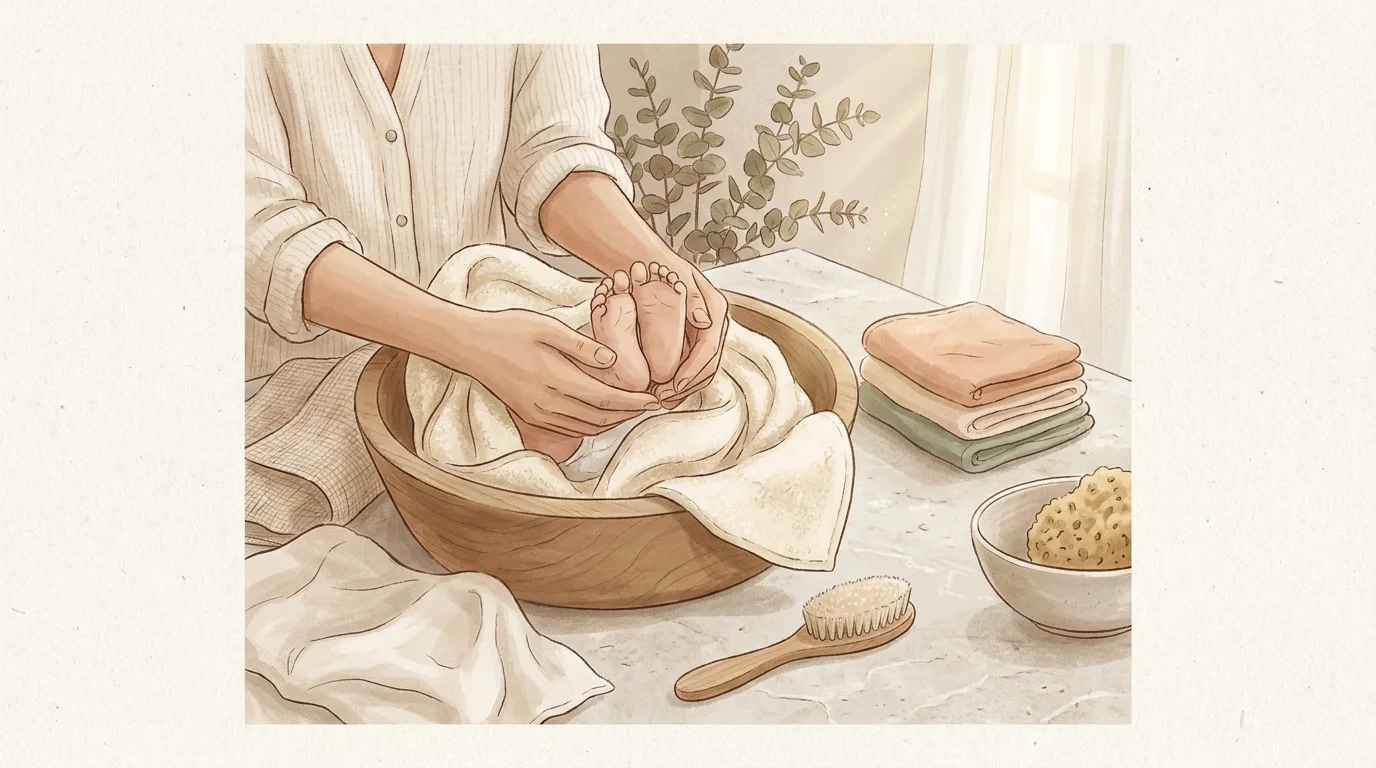
Until the circumcision is fully healed and the umbilical cord stump has also fallen off, stick to sponge baths rather than submersion baths. Submerging the healing site before it has closed can introduce bacteria and slow healing. Gently clean around the area with a warm, damp cloth and dry it carefully before applying petroleum jelly and a fresh diaper.
Once both the circumcision site and the cord stump have healed completely, you can transition to regular tub baths. At that point, no special cleansing of the area is needed beyond gentle washing with plain warm water during bath time.
"One of the most consistent things I tell new parents is not to overthink the bathing piece. Sponge baths are entirely adequate for newborns in those first weeks, and they protect both the cord stump and the circumcision site while both heal simultaneously."
Dr. Claire McCarthy, MD, Pediatrician and Senior Faculty Editor, Harvard Health Publishing, Harvard Medical School
Normal vs. Concerning: How to Tell the Difference
One of the trickiest parts of newborn circumcision care is distinguishing between what is completely normal and what warrants a call to the pediatrician. Here is a clear breakdown:
Normal Signs of Healing
- Mild redness around the tip of the penis
- Small amount of swelling in the first few days
- Yellow or white film forming over the wound (granulation tissue)
- Light spotting on the diaper in the first 24 hours
- Fussiness and discomfort, especially during diaper changes
- Skin looks slightly uneven or bruised in the first few days
Signs That Require a Call to Your Pediatrician
- Bleeding that soaks more than a quarter-sized area on the diaper, or any active oozing that does not stop with gentle pressure
- Redness that is spreading beyond the tip of the penis onto the shaft or surrounding skin
- Significant or worsening swelling after day three
- Fever (rectal temperature of 100.4°F or higher in a newborn always requires prompt evaluation)
- Your baby has not urinated within 6 to 8 hours after the procedure
- The Plastibell ring has not fallen off by day 10, or appears to be migrating
- The wound has a foul smell or discharge that looks thick and greenish rather than the normal yellowish film
- You notice the skin of the shaft adhering to the glans (this may indicate a developing adhesion)
Pain Management for Your Baby
Newborns feel pain, and discomfort after circumcision is real, even if babies cannot articulate it. Research published by the American Academy of Pediatrics (AAP) via the National Institutes of Health has emphasized that adequate pain relief both during and after circumcision is essential. In the hospital, local anesthesia is standard practice. After discharge, pain management is largely supportive:
- Feeding on demand: Breastfeeding or bottle feeding provides comfort and pain relief through the release of endorphins and the closeness of holding.
- Skin-to-skin contact: Holding your baby chest-to-chest regulates their stress response and has been shown to reduce pain perception in newborns.
- Gentle swaddling: Snug, secure swaddling can help soothe a fussy baby, though avoid putting pressure directly on the healing site.
- Sucrose solution: Some hospitals send families home with information about oral sucrose as a short-term comfort measure. Ask your care team if this is appropriate for your baby.
- Acetaminophen: Your pediatrician may recommend infant acetaminophen for the first 24 to 48 hours after discharge. Never administer any medication to a newborn without explicit guidance from your provider, including correct dosing based on your baby's weight.
Long-Term Care: After Healing Is Complete
Once the circumcision site has fully healed, ongoing care is minimal. During bath time, gently clean the area with warm water. Soap is not necessary and can be drying. As your son grows, you may notice the skin of the shaft occasionally adhering lightly to the edge of the glans. These are called penile adhesions and are relatively common. Most resolve on their own, but your pediatrician should be aware of them and can advise whether any intervention is needed at well-child visits.
The American Academy of Pediatrics notes that the health benefits of male circumcision outweigh the risks, but that the final decision appropriately rests with parents after discussing the medical, religious, cultural, and personal factors relevant to their family. Whatever decision you have made, you are your child's best advocate, and learning how to care for them well is always the right move.
Key Statistics and Sources
- Approximately 58.3% of male newborns in the U.S. were circumcised in hospital settings as of recent national data (CDC, National Center for Health Statistics).
- Complications from newborn circumcision are uncommon, estimated at between 0.2% and 0.6% of procedures when performed by trained clinicians (NIH/AAP).
- The most common complications are minor bleeding and local infection, both of which are highly treatable when identified early (AAP HealthyChildren.org).
- Skin-to-skin contact has been shown to reduce procedural pain scores in newborns by measurable margins in multiple clinical studies (NIH).
- The Plastibell ring, one of the most commonly used circumcision devices, typically separates naturally within 5 to 8 days post-procedure (AAP).
- The AAP updated its circumcision policy statement to affirm that the health benefits outweigh the risks, though it stops short of a universal recommendation, leaving the decision to families.