Understanding Your Newborn's Skin
The moment you hold your newborn for the first time, you notice just how impossibly soft their skin feels. But that softness comes with fragility. A baby's skin is not simply a smaller version of adult skin; it is structurally thinner, more permeable, and still developing its ability to regulate moisture and respond to the outside world. For the first few weeks and months of life, caring for that skin thoughtfully can make a real difference to your baby's comfort and long-term skin health.
This guide walks you through everything you need to know: what is normal, what needs attention, which products are safe, and how to build a gentle daily routine that works for your family.
What Normal Newborn Skin Looks Like
Many parents are surprised by how their newborn's skin actually looks at birth and in the days that follow. Understanding what is typical can save a lot of worry.
Vernix Caseosa
At birth, many babies are covered in a creamy white coating called vernix caseosa. Far from being something to wash off immediately, vernix is a protective substance that has been nourishing and waterproofing your baby's skin in the womb. Research published through the National Institutes of Health suggests that leaving vernix on the skin for at least a few hours after birth helps retain moisture and may reduce the risk of infection.
Peeling and Dryness
In the first one to three weeks, most newborns experience some degree of skin peeling, particularly on the hands, feet, and ankles. This is completely normal and simply reflects the transition from the fluid environment of the womb to the drier air outside. It does not require any treatment, and applying heavy creams or oils too early can sometimes disrupt the skin's natural adjustment process.
Milia
Those tiny white or yellowish bumps scattered across your baby's nose, cheeks, or forehead are called milia. They are caused by keratin becoming trapped beneath the surface of the skin and are present in roughly 40 to 50 percent of newborns. They are harmless and disappear on their own, usually within a few weeks.
Newborn Rash (Erythema Toxicum)
A blotchy, red rash with small yellow or white pustules, known as erythema toxicum neonatorum, appears in up to half of all full-term newborns within the first few days of life. Despite its alarming name, it is entirely benign and resolves without treatment. The cause is not fully understood, but it is not infectious and poses no risk to your baby.
"A newborn's skin barrier is still maturing during the first year of life. This means it loses water more easily and absorbs substances from the environment more readily than adult skin. The products and practices we choose in these early months genuinely matter."
Dr. Lawrence Eichenfield, MD, Professor of Dermatology and Pediatrics, UC San Diego School of Medicine
Common Newborn Skin Conditions
Beyond the normal variations, there are a handful of skin conditions that commonly affect young babies. Most are manageable at home with the right approach.
Cradle Cap (Seborrhoeic Dermatitis)
Cradle cap presents as greasy, yellowish scales or crusts on the scalp, and sometimes on the eyebrows and behind the ears. It typically appears in the first few weeks of life and can persist for several months. It is not caused by poor hygiene and is not contagious. The underlying cause is thought to be an overgrowth of a yeast called Malassezia, combined with the lingering effects of maternal hormones that stimulate oil gland activity.
Gentle management includes softening the scales with a small amount of natural oil (such as coconut or almond oil) massaged onto the scalp, leaving it for around 15 minutes, then carefully brushing away loosened flakes with a soft-bristled baby brush before shampooing. For persistent or widespread cases, a healthcare provider may recommend a medicated shampoo.
Baby Acne
Small red or white pimples appearing on the face, particularly the cheeks, nose, and forehead, are very common in babies between two and four weeks of age. Like cradle cap, baby acne is linked to maternal hormones passed through the placenta and, if breastfeeding, through breast milk. It resolves on its own, usually within a few weeks to a few months. No special treatment is needed; simply wash the affected area gently with water and a mild baby cleanser.
Eczema (Atopic Dermatitis)
Eczema affects roughly 10 to 20 percent of children and often first appears in infancy, typically after the age of two to three months. It presents as dry, itchy, inflamed patches of skin, most commonly on the cheeks, forehead, and scalp in young babies, and later in the creases of the elbows and knees. The National Eczema Association notes that while there is no cure, consistent moisturising and avoiding known triggers can significantly reduce flare-ups and discomfort.
If you suspect your baby has eczema, consult your paediatrician or a dermatologist. They may recommend a fragrance-free emollient to apply generously and frequently, as well as guidance on identifying triggers such as certain fabrics, heat, or environmental allergens.
Nappy Rash
Nappy rash is one of the most common skin concerns in the first year of life, affecting the majority of babies at some point. It is caused by prolonged contact with urine and faeces, friction, and sometimes an overgrowth of Candida (thrush). Preventive measures include frequent nappy changes, allowing air-dry time where possible, and applying a barrier cream such as zinc oxide paste at each change. If the rash is severe, blistering, or does not improve within a few days, seek medical advice as it may need antifungal treatment.
"When we look at long-term skin health outcomes, the foundations really are laid in infancy. Simple, consistent moisturising and choosing minimal, fragrance-free products in the first year can help protect the skin barrier at a time when it is most vulnerable."
Dr. Amy Paller, MD, Chair of Dermatology, Northwestern University Feinberg School of Medicine
Choosing Safe Products for Your Newborn's Skin
The baby product market is overwhelming. Shelves are lined with lotions, washes, oils, and powders, each claiming to be the gentlest option. Here is what to actually look for and avoid.
What to Look For
- Fragrance-free: Fragrance is one of the most common causes of skin irritation and allergic reactions in babies. "Unscented" and "fragrance-free" are not the same; look specifically for fragrance-free.
- Minimal ingredients: Fewer ingredients means fewer potential irritants. Simple formulas with well-studied components are preferable to complex blends.
- pH-balanced: Newborn skin has a slightly acidic pH that helps protect against bacteria. Products designed to be pH-balanced for baby skin support this natural defence.
- Dermatologist-tested: While not a guarantee, products that have undergone dermatological testing offer some additional reassurance.
What to Avoid
- Fragrances and parfum
- Parabens and phthalates
- Alcohol (ethanol) in leave-on products, as it dries the skin
- Talcum powder, which poses an inhalation risk
- Antibacterial soaps, which are too harsh for newborn skin
The American Academy of Pediatrics advises parents to use as few products as possible on newborn skin and to introduce new products one at a time so that any reaction can be identified easily.
Building a Gentle Daily Skin Care Routine
A simple routine is the most effective routine. Your newborn does not need an elaborate multi-step regimen. Here is what a thoughtful daily approach might look like.
Bathing
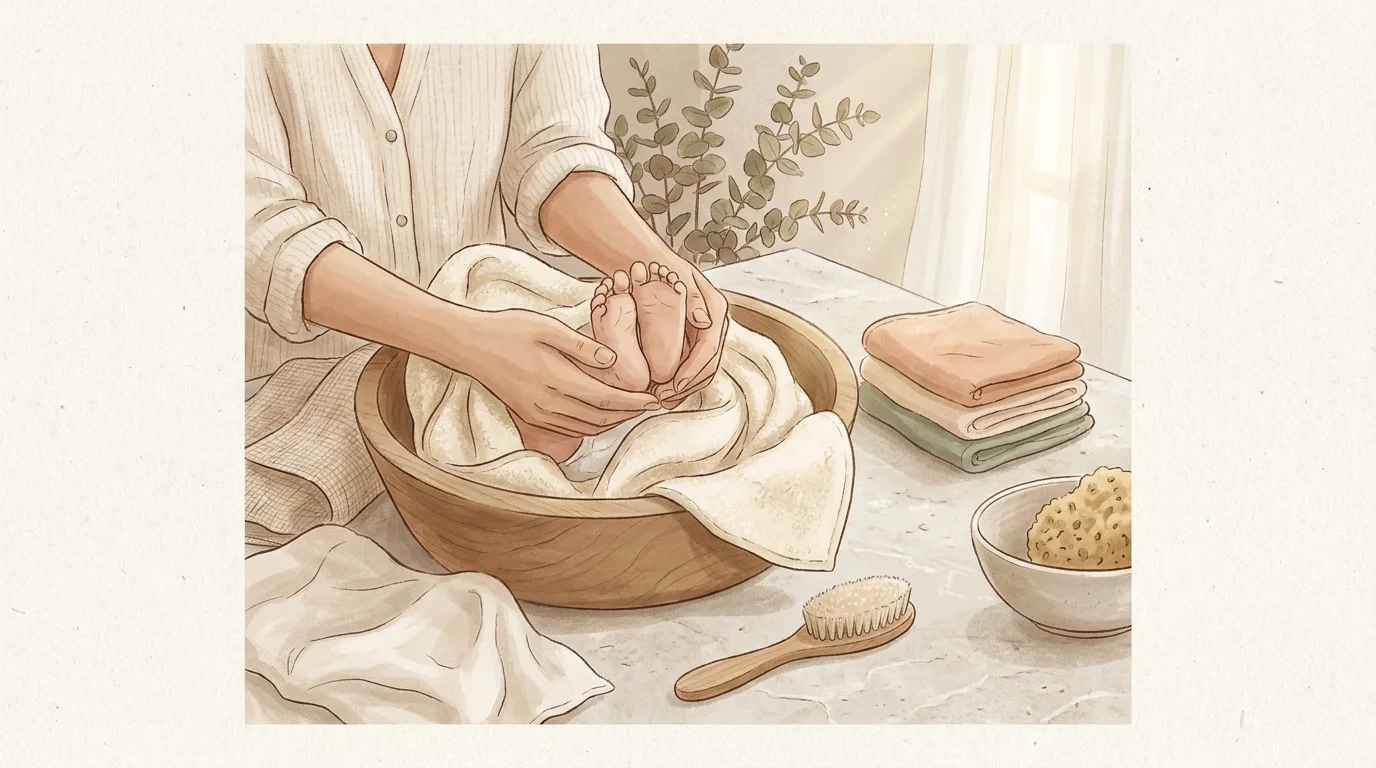
Until the umbilical cord stump falls off (usually between one and three weeks), stick to sponge baths using warm water and a soft cloth. Once the cord has healed, two to three baths per week is sufficient for most newborns. Daily bathing can strip the skin of its natural oils and disrupt the developing barrier. Use a mild, fragrance-free baby wash and keep bath time brief, around five to ten minutes, in warm (not hot) water.
Moisturising
Apply a fragrance-free baby lotion or emollient immediately after bathing, while the skin is still slightly damp. This helps lock in moisture. For babies with very dry skin or early signs of eczema, more frequent application, including in the morning and evening, may be beneficial.
Sun Protection
Newborn skin is extremely sensitive to UV radiation, and sunscreen is generally not recommended for babies under six months of age. The primary approach for this age group is sun avoidance: keep your baby in the shade, use a pram with a UV-protective cover, and dress them in lightweight, long-sleeved clothing and a wide-brimmed hat when outdoors. After six months, a mineral sunscreen (containing zinc oxide or titanium dioxide) formulated for babies can be applied to exposed skin.
Nappy Area Care
At each nappy change, clean the nappy area with fragrance-free wipes or plain warm water. Pat dry rather than rubbing, and apply a thin layer of barrier cream. This simple routine, done consistently, is your best defence against nappy rash.
Key Takeaway
Your newborn's skin is still developing its protective barrier. The most effective care strategy is also the simplest: gentle cleansing two to three times a week, consistent moisturising with fragrance-free products, diligent nappy care, and avoiding unnecessary products. When in doubt, less is more.
When to See a Doctor
Most newborn skin concerns are normal and self-resolving, but there are times when professional advice is important. Contact your paediatrician or healthcare provider if you notice:
- A rash accompanied by fever or lethargy
- Blistering or weeping skin
- Skin that appears yellow (jaundice)
- Nappy rash that has not improved after three to four days of home treatment
- Eczema that is severe, widespread, or not responding to moisturising
- Any skin change that concerns or worries you
Trust your instincts. You know your baby better than anyone, and there is never a wrong reason to seek reassurance from a professional.
Key Statistics and Sources
- Up to 50% of newborns develop erythema toxicum neonatorum in the first days of life. NIH, National Library of Medicine
- Atopic dermatitis (eczema) affects 10-20% of children, with onset often in the first months of life. National Eczema Association
- Newborn skin has a pH of around 6.3 at birth, dropping to approximately 4.9 within the first month as the acid mantle develops. NIH, National Library of Medicine
- Milia are present in approximately 40-50% of newborns and resolve without treatment. NIH, National Library of Medicine
- The AAP recommends avoiding sunscreen on babies under 6 months and prioritising shade and protective clothing instead. American Academy of Pediatrics
- Vernix caseosa has demonstrated antimicrobial properties, supporting delayed bathing of at least a few hours after birth. NIH, National Library of Medicine