Bath Time With Your Newborn: More Than Just Clean
Those first bath times with your newborn can feel equal parts magical and terrifying. A slippery, squirming baby, a tiny body that seems almost too fragile to handle, and the very real worry that you might do something wrong. The good news? You almost certainly will not. Bathing a newborn is one of those skills that feels overwhelming before you do it and surprisingly manageable once you have a few sessions under your belt.
But bath time is so much more than hygiene. The warm water, your steady hands, the sound of your voice explaining what you are doing: these are powerful sensory experiences for your baby. Research consistently links gentle touch, skin-to-skin contact, and calm interaction with improved infant wellbeing and stronger parent-child attachment. Bath time, done with presence and warmth, is an early bonding ritual that many families end up treasuring for years.
This guide will walk you through everything, from how often to bathe your newborn, to the sponge bath stage, to that first tub bath, plus common concerns and how to handle them.
How Often Does a Newborn Actually Need a Bath?
One of the most persistent myths in newborn care is that babies need daily baths. They do not. In fact, bathing a newborn too frequently can strip the delicate skin of its natural oils, contributing to dryness and irritation.
The American Academy of Pediatrics (AAP) recommends bathing newborns just two to three times per week. On non-bath days, a gentle wipe-down of the face, neck folds, diaper area, and any skin creases is all that is needed. This approach keeps your baby clean without disrupting the protective barrier function of their skin.
"Newborn skin is significantly thinner and more permeable than adult skin, which means it loses moisture more rapidly and is more vulnerable to irritants. Less frequent bathing and the use of mild, fragrance-free products are genuinely protective, not just cautious."
- Dr. Anthony Mancini, MD, Head of Dermatology, Ann & Robert H. Lurie Children's Hospital of Chicago
The Sponge Bath Stage: Waiting for the Umbilical Cord
Until your baby's umbilical cord stump falls off (usually somewhere between one and three weeks after birth), you will be giving sponge baths rather than immersion baths. This is because keeping the stump dry helps it to heal and detach properly. Submerging the area in water before it has healed increases the risk of infection.
The Eunice Kennedy Shriver National Institute of Child Health and Human Development (NICHD) advises waiting until the cord stump has fully dried, detached, and the navel area has healed before moving to tub baths. The same applies if your baby has been circumcised: wait until the area has healed fully.
How to Give a Sponge Bath
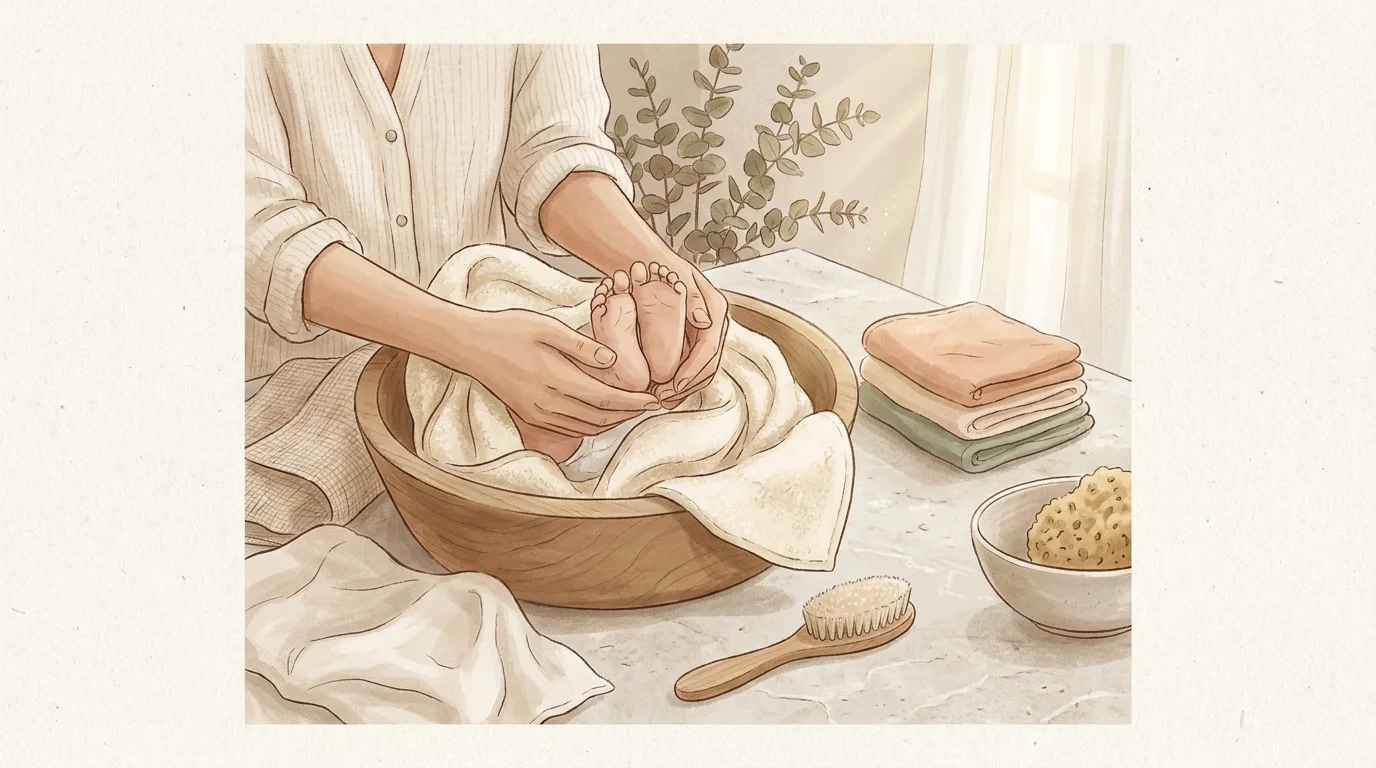
Sponge baths are simple once you have a routine. Here is what works well:
- Gather everything first. A warm room (around 75°F or 24°C), a soft towel or changing mat, a bowl of warm water (test it on your inner wrist), a soft washcloth, mild fragrance-free baby wash, a clean nappy, and a fresh outfit.
- Keep your baby warm. Undress only the part of the body you are cleaning at any given moment, and wrap the rest in a towel. Newborns lose heat quickly.
- Work top to bottom. Start with the face using plain water, then move to the neck folds, behind the ears, and down the body. Always clean the genital area last.
- Be gentle in the folds. Milk residue and sweat collect in neck rolls, underarm creases, and behind the knees. These areas need careful but gentle attention.
- Pat dry, do not rub. Newborn skin is sensitive. Patting dry, especially in the folds, prevents irritation.
Moving to the Tub: Your Baby's First Full Bath
Once the cord stump is gone and any healing is complete, you can introduce your baby to a baby tub or a clean sink with a soft insert. Many parents feel a new surge of nerves at this point. That is completely normal. The key is preparation and a calm, unhurried approach.
Setting Up for Safety and Comfort
Baby bath safety is straightforward but non-negotiable. The Centers for Disease Control and Prevention (CDC) notes that drowning is a leading cause of unintentional injury death in children, and that it can happen in very small amounts of water. This is why you should never leave your baby unattended in the bath, even for a second, even with a bath seat or support device.
- Fill the baby tub with only two to three inches of warm water.
- Test the temperature carefully: it should feel comfortably warm on your wrist or elbow, ideally around 98-100°F (37-38°C). Use a bath thermometer if you have one.
- Have everything within arm's reach before you put your baby in the water.
- Keep one hand on your baby at all times.
- Set your water heater to no higher than 120°F (49°C) to prevent scalding at the tap.
"Parents often underestimate how quickly the bath environment can go from safe to dangerous if attention shifts. The rule is simple: if you need to leave the room, take the baby with you. No phone call or doorbell is worth the risk."
- Dr. Danielle Dooley, MD, MPhil, General Pediatrician and Child Health Advocate, Children's National Hospital, Washington D.C.
Step by Step: The First Tub Bath
Here is a gentle sequence that keeps your baby secure and calm:
- Lower your baby in feet first, supporting the head and neck with one hand and the bottom with the other. Speak calmly and make eye contact throughout.
- Use your free hand to wash, keeping the supporting arm under your baby's head and shoulders the entire time.
- Start with the face and scalp, using a soft washcloth and a tiny drop of gentle, tear-free baby wash on the hair if needed. A gentle backwards tilt of the head as you rinse keeps water from the face.
- Work down the body, paying attention to all the folds. Lift legs gently to clean the nappy area last.
- Lift out carefully by sliding both hands under the baby: one supporting the head and shoulders, the other the bottom. Babies are slippery when wet, so have your towel open and ready to wrap immediately.
Choosing the Right Products for Newborn Skin
The market is flooded with baby bath products, but for a newborn, less is genuinely more. In the first few weeks, plain warm water is often sufficient for most of the body. When you do introduce a cleanser, look for:
- Fragrance-free formulas (fragrance is one of the most common causes of contact dermatitis in infants)
- pH-balanced products specifically designed for baby skin
- No added dyes or harsh preservatives
- Tear-free labelling for anything used near the face or scalp
Avoid adult soaps, antibacterial washes, and anything with essential oils or botanical extracts in the early weeks. Even products marketed as "natural" can contain allergens that irritate immature skin.
Understanding Vernix and Why You Should Leave It
At birth, many babies are covered in a white, waxy substance called vernix caseosa. This is not something to be scrubbed away in a hurry. Vernix is a remarkable substance produced by your baby's skin in the womb. It acts as a moisturiser, an antimicrobial barrier, and a temperature regulator in those first hours of life.
The World Health Organization recommends delaying the first bath for at least 24 hours after birth, and ideally for 48 hours, to allow the vernix to be absorbed into the skin. If a hospital or care provider suggests an earlier bath, you have every right to ask for more time.
Bath Time as a Bonding Ritual
Beyond cleanliness, bath time can become one of the richest daily rituals of early parenthood. The combination of warm water, skin contact, your voice, and your face creates an ideal environment for the kind of serve-and-return interaction that builds secure attachment.
Try narrating what you are doing ("I am washing your little toes now"), making eye contact, singing a consistent song each time, or simply being fully present without your phone or other distractions. Babies are exquisitely sensitive to your tone of voice and level of calm. When you are relaxed and focused, they tend to be too.
Over time, a consistent bath routine can also serve as a powerful sleep cue. The warmth of the bath followed by a massage, feeding, and darkness signals to the nervous system that sleep is coming, making it a valuable part of a wind-down sequence from around six to eight weeks onwards.
Infant Massage After the Bath
Many parents find that a simple gentle massage after bath time deepens the connection even further. Using a small amount of fragrance-free baby oil or lotion, you can stroke arms, legs, tummy (using clockwise circles, which can also help with gas), and back. Infant massage has been studied in premature and full-term infants alike, with findings suggesting benefits including improved weight gain, reduced colic symptoms, and lower cortisol levels in both baby and parent.
Common Concerns and How to Handle Them
My Baby Hates the Bath
Some babies genuinely do not enjoy bath time, at least at first. If your newborn screams through every bath, consider: the room temperature (too cold is a common culprit), the water temperature, whether they are hungry or overtired, and how confident your own handling feels. Nervous hands communicate to a baby. The more consistently calm and steady you are, the more likely they are to settle over time. Some babies simply prefer sponge baths longer than others, and that is fine.
Cradle Cap
Cradle cap (seborrheic dermatitis) looks alarming but is extremely common and almost always harmless. It presents as yellowish, flaky, or crusty patches on the scalp. Gentle washing with a soft brush during bath time, and occasionally applying a small amount of baby oil before bathing to loosen scales, is usually all that is needed. It typically resolves on its own within the first year.
Dry Skin and Eczema
If your baby has dry skin or early eczema, shorter baths (five to ten minutes maximum), lukewarm rather than warm water, and applying a thick fragrance-free moisturiser immediately after patting dry can make a significant difference. Lock in moisture while the skin is still slightly damp.
Key Statistics and Sources
- The AAP recommends bathing newborns just 2-3 times per week to protect skin barrier function. AAP, 2024
- Delaying the first bath by at least 24 hours increases breastfeeding initiation rates, according to a 2019 study of hospital practices. NIH/NCBI, 2019
- Drowning is a leading cause of unintentional injury death in children aged 1-4 in the US, with bathtubs representing a significant risk environment. CDC, 2023
- Infant massage after bathing has been shown to reduce crying time and improve sleep in the first months of life. NIH/NCBI, 2013
- Vernix caseosa has demonstrated antimicrobial properties against common neonatal pathogens, supporting delayed bathing practices. NIH/NCBI, 2009
- Cradle cap affects up to 70% of infants in the first three months of life and typically resolves without medical treatment. American Academy of Dermatology, 2023