Why Babywearing Has Stood the Test of Time
Long before strollers, baby carriers were the default. Across cultures and centuries, parents have kept their infants close using cloth, leather, and woven wraps. Today, that ancient instinct is backed by a growing body of research: keeping your baby physically close to your body is genuinely good for both of you. It regulates their temperature, calms their nervous system, supports your milk supply, and frees your hands so you can actually live your life.
Babywearing is not a trend or a parenting philosophy you have to fully commit to. It is a practical, evidence-supported tool you can use as much or as little as suits your family. Whether you reach for a stretchy wrap for the newborn weeks or a structured carrier for a growing baby, understanding the basics helps you do it safely, comfortably, and confidently.
What the Research Says About Carrying Your Baby
The science behind babywearing is more robust than many parents realise. One of the most frequently cited studies found that increased carrying reduced infant crying by 43 percent over baseline levels. That alone is enough to make most sleep-deprived new parents curious.
"Infants who are carried spend more time in a quiet, alert state, which is the optimal state for learning and social engagement. Close physical contact helps regulate the infant's immature nervous system in ways no other intervention consistently replicates."
- Dr. Nils Bergman, MBChB, PhD, Neonatologist and Kangaroo Mother Care Researcher, University of Cape Town
Research published by the National Institutes of Health found that skin-to-skin contact and carrying promote the release of oxytocin in both parent and infant, strengthening attachment and supporting maternal mental health in the postpartum period. Separate work has shown that carried babies demonstrate more stable heart rates, improved oxygen saturation, and better weight gain in the early weeks, particularly relevant for premature or low-birth-weight infants.
For breastfeeding mothers, proximity matters too. Being close to your baby stimulates prolactin, the hormone responsible for milk production. Many mothers find that wearing their baby throughout the day helps establish and maintain supply, especially in the early weeks when feeding cues can be subtle and easy to miss.
Types of Baby Carriers: Finding Your Fit
Walking into a carrier store or browsing online can feel overwhelming. There are stretchy wraps, woven wraps, ring slings, soft-structured carriers, and meh dais, each with different learning curves, weight limits, and use cases. Here is a practical breakdown to help you navigate.
Stretchy Wraps
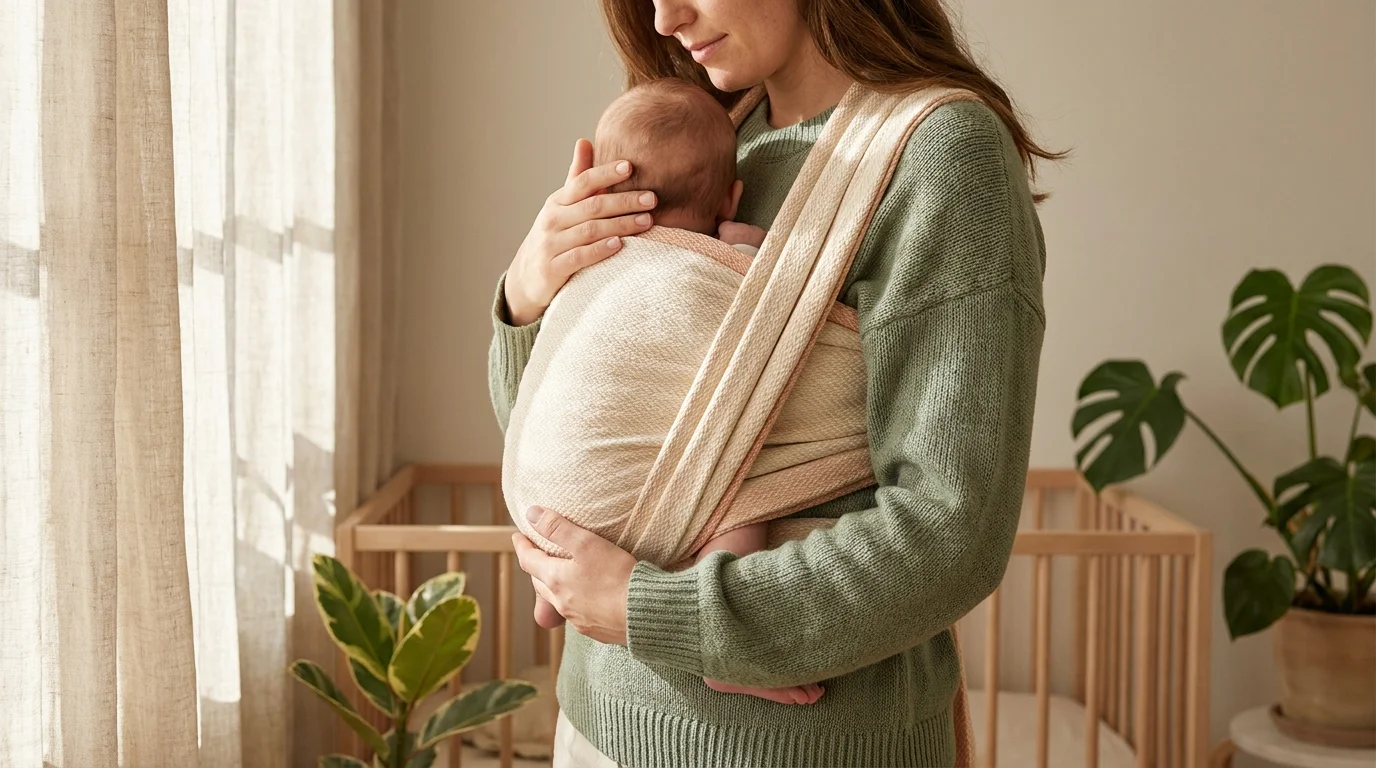
Made from a single long piece of stretchy fabric, these are enormously popular for newborns. The fabric molds to both your body and your baby's, creating a snug, womb-like hold. They distribute weight evenly across your shoulders and hips. The learning curve is gentle, and most parents feel confident after two or three practice sessions. The main limitation is weight: most stretchy wraps become less supportive as babies grow past around 7-8 kilograms, as the fabric sags under heavier loads.
Ring Slings
A single length of fabric threaded through two rings, ring slings offer a quick on-and-off carry that works beautifully for newborns and older babies alike. They sit over one shoulder, which means the weight is asymmetrical, so many wearers alternate shoulders to avoid strain. Ring slings are brilliant for quick carries, feeding on the go, and hip carries as babies get older and more curious about the world.
Soft-Structured Carriers (SSCs)
These are the buckle carriers you have almost certainly seen in the supermarket. Brands like Ergobaby, Lillebaby, and Tula are among the most recognised. They feature padded waistbands, adjustable shoulder straps, and a structured back panel. Many require a newborn insert for babies under around 5 kilograms. SSCs are straightforward to put on, comfortable for long carries, and easy for partners to share. They work from around 3.5 kilograms through to toddlerhood depending on the brand.
Woven Wraps
Woven wraps use a non-stretchy, densely woven fabric that is highly versatile. With enough practice, you can achieve front, back, and hip carries. They have a steeper learning curve than other options but offer exceptional support for heavy babies and long wearing sessions. Woven wraps are often passed between friends, borrowed from libraries, or bought second-hand.
"There is no single 'best' carrier. The best carrier is the one that fits both the parent's body and the baby's developmental stage, is used correctly, and that the parent will actually reach for. Comfort and safety together drive consistent use."
- Dr. Sarah Buckley, MB ChB, Author and Research Fellow, University of Queensland
The TICKS Safety Rules: Non-Negotiable Basics
Babywearing is very safe when done correctly, but positional asphyxia, a rare but serious risk, can occur if a baby's airway is compromised. The UK Sling Consortium developed the TICKS guidelines, which have become the international standard for safe babywearing. Follow these every single time.
The TICKS Rules for Safe Babywearing
- T - Tight: The carrier should be snug enough that your baby cannot slump. Loose fabric allows dangerous chin-to-chest positioning.
- I - In view at all times: You should be able to see your baby's face by simply glancing down, without moving fabric.
- C - Close enough to kiss: Your baby's head should be close enough that you can bend forward and kiss their head without effort.
- K - Keep chin off chest: There must always be a two-finger gap between your baby's chin and their chest. A curled chin compresses the airway.
- S - Supported back: Your baby's back should be supported in a natural curve. A slumped or rounded back can restrict breathing.
Additional safety notes: Never wear your baby while cooking over heat, cycling, running, or doing anything where a fall is possible. Avoid carriers with a head rest that pushes the chin forward. If your baby was born prematurely, has a respiratory condition, or has low muscle tone, speak with your paediatrician before babywearing.
Ergonomics: The "M" Position Matters
The most important thing to understand about how your baby sits in a carrier is the M position, sometimes called the frog position or spread-squat position. When carried correctly, your baby's knees should be higher than their bottom, with their thighs spread around your torso, creating an M shape when viewed from the front.
This position is important for hip development. The International Hip Dysplasia Institute recommends the spread-squat position as hip-healthy and cautions against carriers where the baby's legs hang straight down, as this places undue stress on developing hip joints.
Look for the Hip Healthy label when choosing a carrier, and check that the seat panel extends from knee to knee, fully supporting your baby's thighs, not just their bottom.
Babywearing and Your Own Body: Staying Comfortable
A carrier that hurts you will not be used. Postpartum bodies are recovering, and comfort matters enormously. Here are practical tips for avoiding the most common issues.
Shoulder and Neck Pain
This is typically caused by carrying weight too low, meaning the baby hangs away from your body rather than sitting high and close. Tighten all straps so your baby's weight sits high on your torso, with their head close to your chin. A waistband positioned above your hip bones, rather than on them, also helps transfer weight more efficiently.
Lower Back Pain
If you had back pain during pregnancy or are recovering from a C-section, choose a structured carrier with a wide, padded waistband positioned at your natural waist or just above. Avoid ring slings for long carries if one-sided weight is aggravating any existing asymmetry. Start with short carries of 15-20 minutes and build up gradually as your strength returns.
Wrist Strain
Many new parents experience wrist pain from repetitive feeding, holding, and lifting positions. Be mindful of how you thread ring sling rings or thread fabric through buckles, and take breaks when your hands feel fatigued.
When to Start and How Long to Wear
You can begin babywearing from birth, assuming your baby has no medical contraindications. The newborn stage, particularly the first four to twelve weeks sometimes called the fourth trimester, is when babies most benefit from the transition from womb to world. Constant motion, heartbeat proximity, and warmth closely replicate the sensory environment of the uterus.
There is no prescribed maximum carry time per day. Some parents wear their babies for several hours across multiple sessions; others do one morning carry and that is enough. Follow your baby's cues: a settled, sleeping baby in a correctly fitted carrier is comfortable. A baby who arches away, fusses consistently, or whose colour changes should be removed and checked immediately.
Research from the American Academy of Pediatrics notes that while carrying reduces crying and supports attachment, it does not replace the safe sleep environment. Always transfer a sleeping baby to a firm, flat surface on their back when you are ready to stop wearing, even if they settle well in the carrier during waking hours.
Babywearing for Partners and Non-Birthing Parents
One of the most underappreciated benefits of babywearing is that any caregiver can do it. Partners who wear their baby build oxytocin, skin memory, and confidence independently of the primary feeding parent. This is especially meaningful in the early weeks when a breastfeeding parent may feel like the only one who can soothe the baby. A partner who wears the baby for a morning walk or an evening wind-down creates their own rhythmic bond that is genuinely irreplaceable.
Encourage partners to choose a carrier that fits their body properly. Most structured carriers are highly adjustable across torso lengths and shoulder widths, but ring slings may need re-threading, and woven wraps may need a different size depending on body shape. Many babywearing consultants offer sessions specifically for partners and families, and many local sling libraries allow you to try before you buy.
Common Babywearing Myths, Debunked
Myth: You will spoil your baby by carrying them too much. Research consistently shows the opposite. Responsive caregiving, which includes prompt carrying when a baby signals distress, builds secure attachment and long-term emotional regulation.
Myth: Carriers are only useful for tiny babies. Many parents find their most intensive carrier use happens between four and twelve months, as babies become alert, curious, and sociable but still need closeness and comfort.
Myth: It is unsafe to babywear after a C-section. Most C-section parents can babywear, but should avoid pressure directly on the incision. Ring slings positioned above the scar and structured carriers with soft waistbands worn higher on the torso are often recommended. Always follow your surgeon's specific guidance on weight-bearing activity in the early weeks.
Key Statistics and Sources
- Increased carrying reduced infant crying by 43% in a controlled trial. NIH, PMC1835909
- Skin-to-skin contact promotes oxytocin release in both parent and infant, supporting attachment and maternal mental health. NIH, PMC3223315
- The International Hip Dysplasia Institute endorses the spread-squat M position as hip-healthy for carried infants. IHDI
- Carried babies show more time in quiet, alert states, the optimal state for early learning and social engagement. NIH, PMC1835909
- The AAP recommends all sleeping infants be placed on a firm, flat surface on their back, regardless of where they fell asleep. AAP Safe Sleep
- Proximity to the nursing parent stimulates prolactin production, supporting milk supply establishment in early postpartum weeks. NIH, PMC3223315